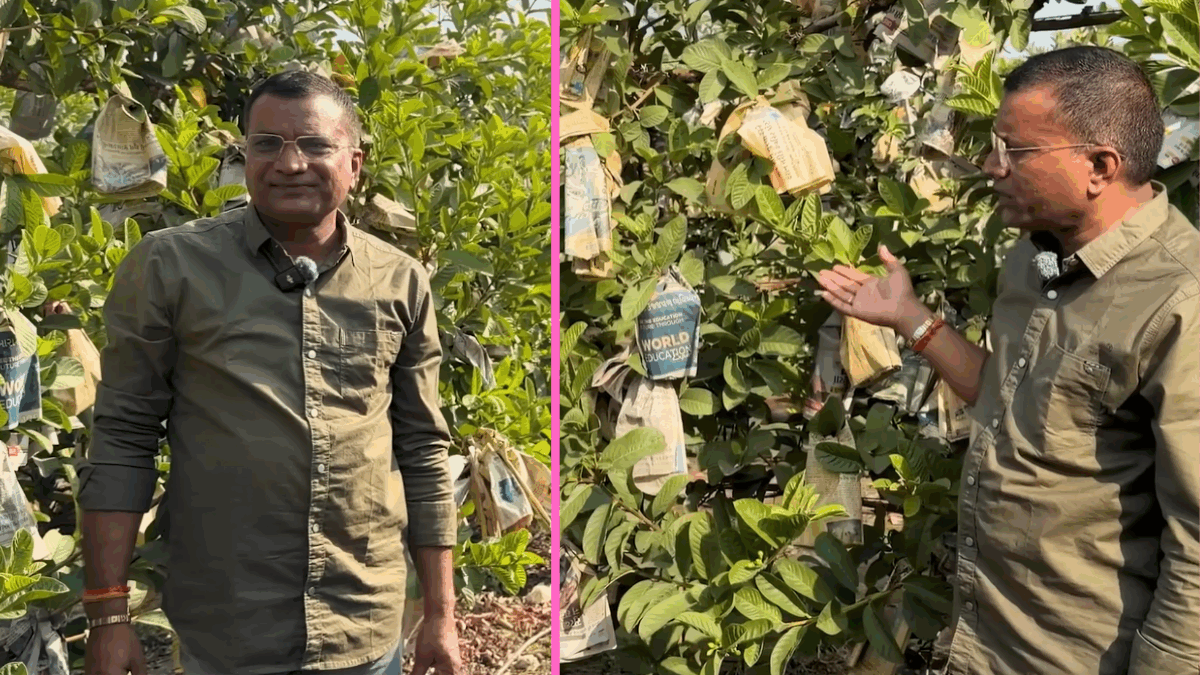
A Shift From Traditional Farming to Innovation
In many parts of India, guava farming still follows traditional methods where plants are grown densely, limiting sunlight and airflow and resulting in lower yields. Farmers often depend on one or two harvest cycles, which leads to unstable income. But in Rupakheda village of Madhya Pradesh, farmer Amrit Patidar is proving that a small change in technique can completely transform farming economics.
Amrit began his journey like most farmers, cultivating soybean and wheat with limited returns. “We used to earn just ₹10,000 to ₹15,000 per bigha,” he says. Like many, he accepted this as the reality of farming until a visit to progressive farms in Raipur around 2012 changed everything.
“There we saw guava plants grown on wires like grapes. At first, we didn’t believe it,” he recalls. “We thought—how will fewer branches give us more production?”
Despite his doubts, the results he saw convinced him to experiment. By 2015, he had adopted the trellis system on his own farm.
What Makes the Trellis System Different
Unlike traditional guava trees that grow in dense, unstructured forms, Amrit trains each plant along horizontal wires supported by a trellis system. The plant grows vertically at first, and then branches are spread across multiple wire levels, creating an open canopy.
“This is just like grape farming,” he explains. “You can see every branch clearly, sunlight reaches everywhere, and the plant stays healthy.”
The benefits are immediately visible. With proper airflow and sunlight, disease pressure reduces, and farm operations become easier. “Even tractors can move inside the farm for spraying and harvesting,” he adds.
Better Spacing, Stronger Plants
Amrit follows a spacing of 13 by 8 feet, allowing around 418 plants per acre. While this is fewer than traditional plantations, each plant performs far better.
“Earlier we also thought fewer plants means less production,” he admits. “But when we did it practically, we saw the opposite.”
Each plant now produces between 40 to 55 kilograms of guava, and total production reaches around 20 tons per acre. However, he is careful not to overburden the plants.
“We don’t push beyond 55 kg per plant,” he says. “If the plant weakens once, it takes a long time to recover.”
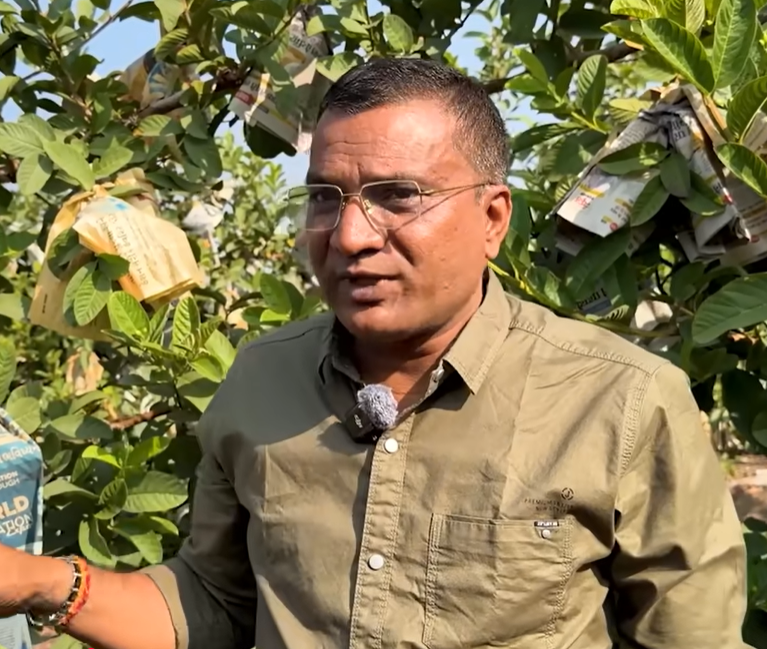
Six Months of Continuous Harvesting
One of the biggest advantages of this system is the extended harvesting period. Unlike traditional farming, where harvesting is limited, Amrit’s farm produces continuously for months.
“Our harvesting starts from October end and continues till May,” he explains. “It keeps going for almost six months.”
This continuous production ensures regular income instead of a one-time earning. “It’s not like everything comes at once and then stops. Income keeps coming,” he adds.
Turning Farming Into a Profitable Business
The financial results are impressive. Amrit earns around ₹7 to ₹8 lakh per acre annually, with costs of ₹2 to ₹2.5 lakh. This leaves him with a net profit of ₹4 to ₹5 lakh per acre.
“If you compare this with soybean or wheat, the difference is huge,” he says. “Farming should be treated like an industry.”
He also highlights the importance of quality in the market. “In the same truck, one farmer’s produce sells at ₹40 and another’s at ₹70 per kg,” he explains. “Quality makes all the difference.”
Scientific Practices Behind His Success
Amrit’s success is built on consistent and scientific farming practices. He prefers planting in April and May to ensure strong root development before the monsoon.
“If you plant before rains, the plant becomes much stronger,” he says. “A two-month difference can make the plant look 8–10 months older.”
He uses drip irrigation with multiple lines to ensure water reaches deep into the soil. For nutrition, he applies organic inputs like cow dung and oil cake mixtures.
“We give 20–22 kg of cow dung per plant every year,” he explains. “Along with that, we use neem, mustard, and other oil cakes.”
Pruning is another critical task. “Work starts right after pruning,” he says. “You have to decide which branches to keep and which to remove.”
Challenges That Need Attention
Despite the benefits, the system comes with challenges. Pests like nematodes and mealybugs can affect the crop if not managed properly.
“Nematodes are inside the soil, and mealybugs attack from above,” he explains. “You have to keep working continuously to control them.”
However, the open structure of the trellis system makes monitoring easier compared to traditional dense farming.
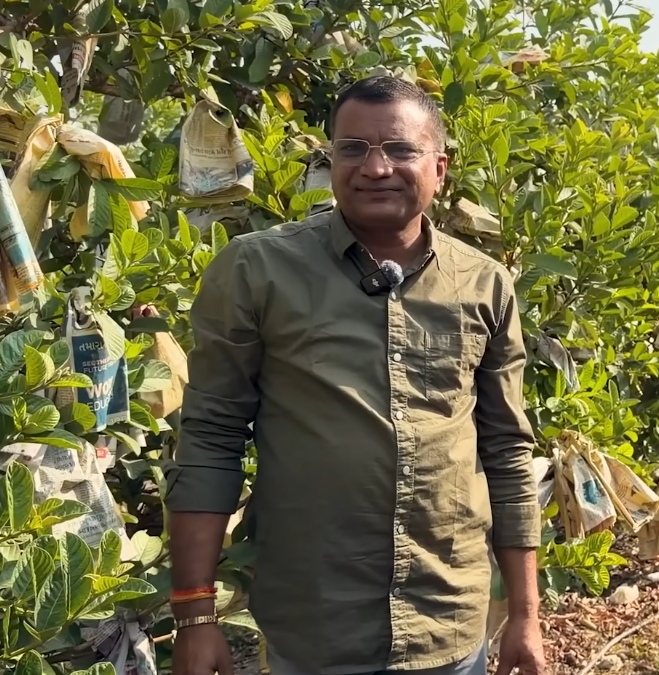
A Clear Warning for Farmers
Amrit is very clear in his advice to other farmers. He cautions against blindly copying what they see online.
“Don’t jump into anything directly after watching videos,” he says. “Many farmers invest without understanding and then face losses.”
Instead, he recommends a gradual approach. “Start with half an acre, learn properly, visit farms, and then expand,” he advises.
Farming as an Industry
For Amrit, farming is not just a tradition—it is a business.
“I believe farming is an industry,” he says. “If you treat it like a business, it will give you income like a business.”
His journey reflects a larger shift in agriculture, where knowledge, planning, and innovation are becoming more important than ever.
The Bigger Lesson
Amrit Patidar’s story is not just about guava farming, but about a shift in mindset. By adopting a trellis system and focusing on plant health, quality, and efficiency, he has transformed a single acre into a sustainable and high-income source.
“If you understand farming properly, it can give you everything,” he says.
His journey highlights that farming is no longer limited to survival—it can become a scalable and profitable venture for those willing to learn, adapt, and apply scientific practices.
Reported based on field interaction and farmer interview in Ratlam, Madhya Pradesh.
Income and yield figures may vary depending on location, soil, and farm management practices.
Sources
Trellis system: https://en.wikipedia.org/wiki/Trellis_(architecture)
Field interview with farmer Amrit Patidar, Ratlam (Madhya Pradesh)
Instagram: https://www.instagram.com/amrit.patidar.9/
Guava farming guide: https://www.agrifarming.in/guava-farming

Leave A Comment